Time for the White (jacket) Men
by | Apr 7, 2026 | 1 Comment
If you wanted to indulge in partisan spin you could wax hotly about the Donald’s Easter morning desecration of the office of the presidency. His meld of profanity, blasphemy and bellicose madness all rolled into a single social media post could surely calls forth at least that much: But we don’t think “desecration” is the right word for it. There had been plenty of that before the Donald got there. Say going back to LBJ’s murderous mayhem in Vietnam, to Bill Clinton’s blow jobs in the Oval Office, to Joe Biden’s chronic drooling on the Resolute Desk.
 But what’s sui generis about this particular desecration is that it involves the POTUS threatening to commit flat-out WAR CRIMES against Iran and mayhem against the global economy based on a screaming Big Lie. Well, actually, a four-part Big Lie that is so utterly refuted by the facts and reality as to stand among the worst excuses for war-making in recorded history.
To wit, none of the following excuses for Trump’s War on Iran is even remotely true:
- Iran has or is on the verge of a nuclear weapon.
- Iran has conducted an unprovoked 47-year war of murder against Americans because the mullahs hate our freedom.
- Iran is arming itself to the teeth for an eventual attack on the American homeland.
- The Iranian government is in the hands of a uniquely Evil Cult of Fanatics determined to bring the world to an Armeggedon-like demise.
Now, we don’t mean that these propositions are arguable wrong or over-wrought exaggerations. Actually, we mean that they are completely, utterly and unequivocally devoid of any truth whatsoever.
Indeed, they are flat out fabrications repeated over and over and over again by the Bibi Netanyahu fifth column on the banks of the Potomac. And they have done so in promotion of a cause – Bibi’s continued tenure in power in Israel—that has nothing whatsoever to do with the Homeland Security of the American people domiciled way over here from sea-to-shinning-sea.
That’s really what makes Trump’s latest rant so horrifically despicable. He is threatening to unleash Armageddon on the 90 million people of Iran and the 7 billion people of the planet who depend for their daily bread upon the fountains of hydrocarbons that ordinarily gush forth into the arteries of global commerce from the Persian Gulf.
We have dealt with the thin gruel of “Iran’s 47-Year War Against America” elsewhere, including the claim that 1,041 Americans have been killed deliberately by the Iranian regime. That is, of course, complete neocon propaganda.
Fully 861 or 83% of these unfortunate deaths occurred in the context of Washington’s misbegotten military deployments in the region – in the Marine barracks in Lebanon in 1983 and during the second US invasion of Iraq in 2003 and thereafter.
Both of these deployments were utterly unnecessary and had no bearing on the Homeland Security of America whatsoever. Washington foolishly put lethally armed US soldiers in the midst of an uprising of the local Shiite population in southern Lebanon in 1983 against the brutal Israeli occupation then underway.
Likewise, the Iraq war fatalities were at the hands of local Shiite militia’s in Iraq. Some of them may have been supplied with weapons from Iran, but they were self-evidently returning war to the Yankee invaders of their homeland who should have never ever been sent there.
So, the overwhelming heart of the case essentially begins and ends with the “nuke” that Iran doesn’t have and hasn’t been seeking since a small weaponization research project was abandoned in 2003. That was done on the orders of Ayatollah Khamenei who issued a Fatwa proclaiming that the development, stockpiling or use of nuclear weapons is forbidden by Islamic Law.
And, yes, we do adhere to Ronald Reagan’s principle of “trust but verify”. That is to say, the 17 US intelligence agencies – who’s remit, budgets, manpower and big oar in the policy waters on the Potomac have had every incentive to find reasons for exaggerating the threat of Iran getting a nuke – have been saying loudly the opposite for the past 19 years.
That is. Nope. No cigar. No way Jose.
This started with the 2007 NIE (National Intelligence Estimate), which is a consensus product of all the agencies from the CIA to NSA (National Security Agency) to Army Intelligence to the Department of State and the CGI (Coast Guard Intelligence). This NIE stated with “high confidence” that Iran had had a small, secret research program on nuclear weaponization but abandoned it in 2003:
“We judge with high confidence that in fall 2003, Tehran halted its nuclear weapons program… Tehran’s decision to halt its nuclear weapons program suggests it is less determined to develop nuclear weapons than we have been judging since 2005.” — U.S. National Intelligence Estimate, “Iran: Nuclear Intentions and Capabilities,” November 2007
In major part, the 2007 NIE was aimed at debunking a 2002 Israeli propaganda offensive suggesting the opposite – that Iran was close to weaponization. But much of that information came from the Mujahedin-e Khalq (MEK), an Iranian dissident group with a long history of providing fabricated or exaggerated claims to Western governments.
This included a major role in providing the false intelligence about what turned out to be Saddam Hussein’s non-existent WMDs. Later investigations, in fact, showed that many of the supposed “Iran has a nuke” documents sourced from the MEK were either planted or heavily edited. So the crucial 2007 NIE effectively debunked the most alarmist of these Israeli claims.
In this time period, President George W. Bush–no wallflower when it came to starting foreign wars – terminated a planned neocon inspired US attack on Iran owing to this same 2007 NIE. As he later admitted in his memoir “Decision Points”, he had been ready to order military strikes on Iran’s nuclear sites much like the Donald’s bunker buster campaign of this past June, but the NIE had “pulled the rug out from under” any immediate military option:
“… The NIE didn’t just undermine diplomacy. It also tied my hands on the military side. There were many reasons I was concerned about undertaking a military strike on Iran, including its uncertain effectiveness and the serious problems it would create for Iraq’s fragile young democracy. But after the NIE, how could I possibly explain using the military to destroy the nuclear facilities of a country the intelligence community said had no active nuclear weapons program?”
Thereafter, Iran continued uranium enrichment activities that it had started in 2006 in order to produce fuel grades material (< 4% U-235) for its large nuclear power plant at Bushehr. These were levels far below what is needed for a bomb (90%+ purity) and was done in a manner generally consistent with its obligations as a signatory of the Nuclear Nonproliferation Agreement (NPT). During this period (2007 to 2015) Iran’s enrichment activities included a small volume (360 Kgs) of 20 percent medical grade material, but the stockpile remained small and was under IAEA monitoring all the while.
According to subsequent intelligence community findings there was no credible evidence of any resumed weaponization work at Iranian facilities, either overt or covert after 2007. So diplomatic efforts intensified during the Obama Administration, culminating in the 2015 Joint Comprehensive Plan of Action (JCPOA).
Under the JCPOA Iran agreed to dispose pursuant to IEA supervision more than 98 percent of its enriched uranium stockpile of about 9,000 kilograms, even though the overwhelming bulk of it (@8,630 Kg) was fully legal <4% reactor fuel grade material.
Beyond that, it also agreed to dismantle two-thirds of its centrifuges and convert its Fordow facility to research functions only. In return, economic sanctions were to be lifted and thereafter the IAEA was authorized to conduct the most intrusive inspection regime ever applied to any country.
From 2016 through early 2018, moreover, the IAEA issued 12 consecutive reports verifying that Iran had no diversion of nuclear material and no undeclared activities. Enrichment stayed at 3.67 percent — the level needed for civilian power reactors. Stockpiles remained within agreed limits. Iran kept its side of the bargain.
Nevertheless, on May 8, 2018 Trump 45 withdrew the United States from the JCPOA. He reimposed the full suite of sanctions that had been lifted, plus new ones targeting oil sales, banking, and shipping. This so-called “maximum pressure” campaign aimed to force Iran back to the table on harsher terms.
But here’s the thing. Iran had actually adhered to both the letter and spirit of the Obama deal and thereby had put its civilian enrichment program under a system of airtight international safeguards monitored by the IAEA. That is, they made huge concessions on nearly every issue that makes a difference.
This included the number of permitted centrifuges at Natanz, the status of the Fordow and Arak facilities, the disposition of their enriched uranium stockpiles, the intrusiveness and scope of the inspections regime and on braking mechanisms with respect Iran’s so-called “breakout” capacity.
While every signatory of the non-proliferation treaty has the right to civilian enrichment, Iran had agreed to reduce the number of centrifuges by 70% from 20,000 to 6,000 and actually did so after the deal took effect. Moreover, its effective enrichment capacity had been reduced by significantly more than 70% because the remaining Natanz centrifuges consisted exclusively of its most rudimentary, outdated equipment – slow, low-yielding first-generation IR-1 knockoffs of 1970s European models.
The disposition of the heavy water reactor at Arak is even more dispositive. For years, the Netanyahu neocons had falsely waved the bloody shirt of “plutonium” because the civilian nuclear reactor being built there was of Canadian “heavy water” design rather than GE or Westinghouse “light water” model; and, accordingly, when finished it would have generated plutonium as a waste product rather than conventional spent nuclear fuel rods.
In truth, the Iranians couldn’t have bombed a beehive with the Arak plutonium because you need a reprocessing plant to convert it into bomb grade material. Needless to say, Iran had no such plant, no plan to build one, and no prospect for getting the requisite technology and equipment on the international market.
But even that bogeyman was dispatched by the nuke deal. The latter required Iran to destroy or export the heavy water reactor core of its existing plant and replace it with a core that cannot produce material which can be reprocessed into weapons grade plutonium. All of these requirements were subject to rigorous international inspection and, in fact, were complied with before Trump cancelled the deal.
As to its already existing enriched uranium stock piles, including some 20% medical-grade material, 97% of this material was to be disposed of, and that requirement was complied with, too. Iran ended up with only 300 kilograms of fuel-grade material out of its 10,000 kilogram stockpile.
As it happened, that was an amount that could have been readily stored in the Donald’s wine cellar at Mar-o-Lago. And, in fact, that’s all Iran had at the time of Trump’s cancellation of the JCPOA, according to the IAEA reports.
The deal’s real clincher, however, had been Iran’s agreement to what amounted to a 20-year cradle-to-grave inspection regime encompassing the entire nuclear fuel chain. International inspectors were allowed to visit Iran’s uranium mines and milling and fuel preparation operations, its enrichment equipment manufacturing and fabrication plants and the storage facilities for its centrifuge rotors and bellows production.
Beyond that, Iran had also agreed to and had complied with a robust program of inspections to prevent smuggling of materials into the country to illicit sites outside of the framework facilities. That encompassed imports of nuclear fuel cycle equipment and materials, including so-called “dual use” items which are essentially civilian imports that could be repurposed to nuclear uses, even peaceful domestic power generation.
In short, not even a Houdini could have secretly broken-out of the box contained in the JCPOA agreement and then confronted the world with some kind of fait accompli threat to use the bomb. To do so would have required diversion of thousands of tons of domestically produced or imported uranium and the illicit milling and upgrading of such material at secret fuel preparation plants.
It would also have involved the secret construction of new, hidden enrichment operations of such massive scale that they could house more than 10,000 new centrifuges and the building of these massive spinning arrays from components smuggled into the country and transported to remote enrichment operations undetected by the massive complex of spy satellites overhead and covert US and Israeli intelligence agency operatives on the ground in Iran.
Finally, it would have required the activation from scratch of a weaponization program which had been dormant according to the US National Intelligence Estimates (NIEs) for more than a decade.
That’s right. Fully dormant for more than a decade. Yet the threat that the Donald supposedly averted by shit-canning the Obama deal was that the Iranian regime – after cobbling together one or two bombs without testing them or their launch vehicles – would nevertheless have been willing to threaten to use them sight unseen.
In short, the case against the JCPOA was rampant hogwash. It’s only purpose was to kill the deal so that Bibi Netanyahu would again be in a position of wave the bloody shirt of an Iranian nuke for purposes of domestic politics and keeping his Washington servitors on a short leash!
The truth is, there never was a plausible or rational basis for the Donald’s bombastic claim that the Obama nuke deal was fatally flawed. So in cancelling the deal, what Trump really did was embrace the immense tissue of lies beneath the unwarranted demonization of Iran that Bibi Netanyahu and the Empire Firsters on the banks of the Potomac had fabricated over the course of three decades.
In any event, subsequent to the Donald’s foolish cancellation of the JCPOA in May 2018 Iran responded by gradually increasing its enriched stockpile levels as self-evident bargaining leverage for an expected new round of negotiations. Even then, it continued to allow IAEA inspectors access and publicly stated it would return to full compliance if the U.S. rejoined the deal.
Accordingly, the U.S. National Intelligence Estimates after 2018 continued to assess that Iran was not actively pursuing weaponization. The 2019, 2020, and subsequent NIEs all repeated the core finding: To wit, Iran had not restarted the weaponization program halted in 2003.
The intelligence community’s position remained unchanged even as enrichment levels rose. For instance, an unclassified July 2023 report under the Biden Administration again attested that –
Unclassified ODNI Report on Iran’s Nuclear Weapons Capability (July 2023 edition): “Iran is not currently undertaking the key nuclear weapons-development activities that would be necessary to produce a testable nuclear device…”
Finally, as recently as March 2025 Trump’s own Director of National Intelligence, Tulsi Gabbard, testified before Congress that Iran still did not have a nuclear weaponization program. She stated the assessment was based on the latest all-source intelligence and that no new evidence had emerged contradicting the long-standing conclusion. Her testimony was direct and unambiguous.
Weeks later, Gabbard’s deputy, Joe Kent, a former CIA officer, essentially confirmed the same point in a public hearing. He noted that while Iran had accumulated more enriched material, theweaponization infrastructure and design work remained dormant.
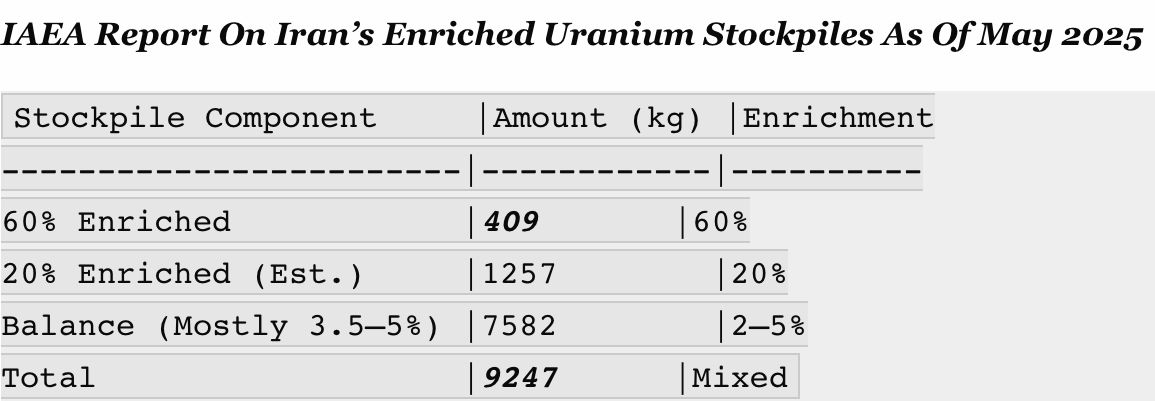
Needless to say, even the small 420 kilogram (kg) stockpile of 60% enriched uranium (out of total stocks of about 9,200 kg) that the International Atomic Energy Agency says Iran had at the time of the subsequent June bombing had been produced for bargaining chip purposes in the context of the negotiations with the Trump Administration then underway.
As a NPT (nonproliferation treaty) signatory and operator of the aforementioned large civilian nuclear reactor at Bushehr, Iran was allowed to have the 7,582 kilograms of civilian reactor grade enriched uranium that the IAEA also certified last spring, as well as the 1,257 kilograms of medical grade uranium (20%).
What was really up for debate was just the 409 kilograms of 60% enriched material in its possession that could be spun to 90% weapons grade in a relatively short time. But for crying out loud, it is goddamn obvious to anyone not looking for an excuse for war that Iran had produced this material as of last June as trading bait for a new nuke and sanctions lifting deal.
That is, in order to get a new nuke deal with Washington to replace the one the Donald himself unilaterally cancelled in 2018, and thereby pave the way for lifting the brutal and demented economic sanctions that Washington has again imposed on Iran.
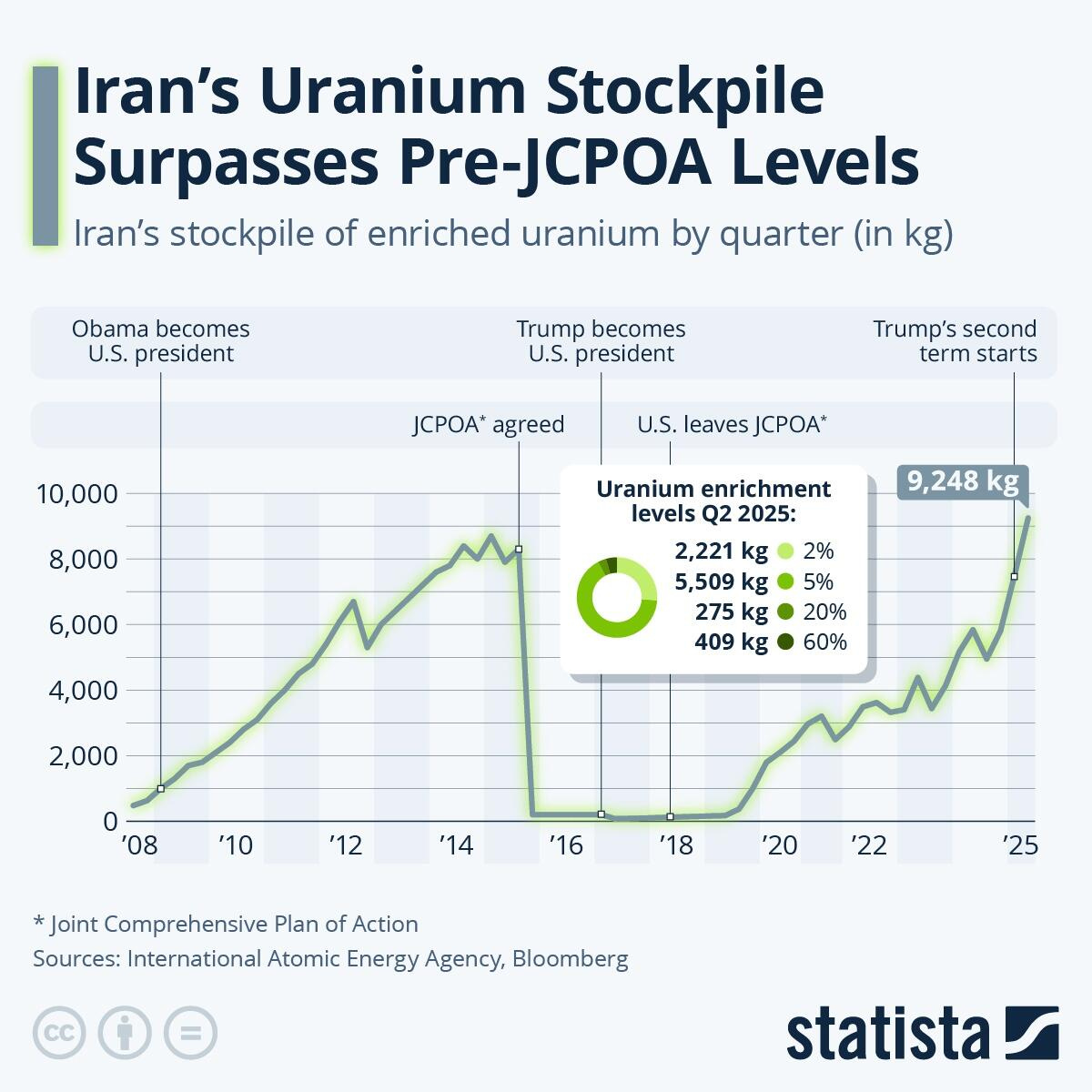
The proof of the bargaining chip pudding could not be more evident in the graph below. During the 10-year run-up to the 2015 nuke deal with the Obama Administration, the Iranians increased their enriched uranium stockpiles to just slightly below the current level, to about 9,000 kilograms.
But in an almost mirror image of the present, fully 96% of that amount was fuel-grade material at <4%, with about 350 kilograms of that material enriched to the 20% purity level for medical grade uses. That is to say, most of the 2015 stockpile was generated as a bargaining chip, and that was exactly its fate.
Upon activation of the JCPOA in 2015, all of the 20% material was destroyed as certified by the IAEA. At the same time, the total stockpile of fuel-grade material was also reduced by 97% to de minimis working levels, as further certified by the IAEA.
Indeed, Iran ended up retaining only 300 kilograms of its 9,000 kilogram stockpile. As mentioned above, however, the Donald had recklessly canceled the deal in May 2018 on the grounds that it had to be a bad deal by definition because he didn’t negotiate it!
Of course, that foolish move only caused the Iranians to restart the stockpiling process yet again, as is so explicitly depicted by the green line in the graph below. The irony, therefore, is that after the Donald’s feckless June 2025 bombing campaign the Iranians likely had close to 100% of the 9,248 kilograms (including the 409 Kg of 60% material) held before June still in tact.
That’s based on pretty convincing satellite photos showing that all of the Donald’s amateur “art of the deal” head fakery last June about “two weeks to decide” before the actual the bombing runs enabled the Iranians to drive trucks up to the Nantanz and Fordow facilities and remove the stockpiles to safe sites elsewhere.
Stated differently, Obama negotiated the Iran enriched stockpile to down by about 97%, while the Donald bombed roughly the same level of stockpile from 9,248+ kilograms to, well @ 9,248 Kg.
And yet and yet. The “obliterated” material was neither illegal, even remotely anything like a real nuke and likely not obliterated, either. Yet the 9,247 Kg of enriched uranium, and especially the 409 Kg of 60% material has became just the latest iteration of the flat-out Big Lie that Netanyahu has been telling for decades.
Indeed, the Netanyahu’s “imminent bomb” lie never stops reincarnating. In the days before the Trump/Netanyahu Feb. 28 attacks, the US and Iran were in productive discussion – during which the Iranian negotiator had explained to Ambassador Witcoff and Jared Kushner that the 409 Kg of 60% material could be made into approximately 10 nukes based on the math of bomb engineering.
Their point, of course, is that like in 2015 they were willing to give up the entirely of the 409 Kg plus most of the 8,838 Kg of fuel grade and medical grade material in return for a comprehensive deal and the lifting of the harsh economic sanctions. That Iranian offer, in fact, has been verified by both British and IAEA representative in the meetings, as well as the Oman foreign minister who had been the chief intermediary.
Unfortunately, the Donald’s negotiators in the persons of his crooked son-in-law and a thoroughly ignorant NYC real estate developer apparently missed the point entirely. They construed it as a threat to make 10 bombs within a matter of weeks, which is absolute baloney that anyone with a modicum of technical knowledge would recognize.
The fact is, enrichment from 60% to 90% is the easy part – it just requires running the centrifuges for another few weeks. The hard part is the engineering steps need to build a functional nuclear weapon from this 90% material, which requires sophisticated design work, precise machining of the core, reliable detonators, and a delivery system that can survive extreme re-entry heat and other stresses.
Stated differently, the dog that hasn’t barked with respect to the “two weeks to a nuke” lie is something called the “physics package” in the trade, which is the sine qua non to make a workable nuke.
The latter requires a precisely engineered device that can achieve supercriticality in a fraction of a microsecond. That is what actually initiates an uncontrolled chain reaction.
In practical terms, this means the fissile material (90% enriched U-235) must be compressed so rapidly, powerfully and uniformly that the number of neutrons produced by fission exceeds those lost to escape or absorption, causing the chain reaction to multiply exponentially in an uncontrollable burst. The entire nuclear explosion unfolds in roughly one millionth of a second — releasing energy equivalent to thousands of tons of TNT before the device physically blows itself apart.
Historically, there have been two basic designs for the physics package: The simpler gun-type device (used only once, on Hiroshima) and the far more efficient implosion-type design (used on Nagasaki and in virtually all modern weapons). According to US intelligence, Iran has never demonstrated mastery of either approach in a deliverable configuration. And that is something anyone can look up via Grok 4 or any similar AI.
In any event, the implosion design favored by all proliferators to date is excruciatingly demanding. It can be envisioned as having a hollow sphere or “pit” of weapons-grade uranium, roughly the size of a grapefruit, at the center of the device. This “pit” is then surrounded by a tamper/reflector and finally around the outside of the latter lies a precisely synchronized shell of conventional high explosives.
The functions of each of these two outer layers, which wrap around the U-235 “pit” of the bomb, are crucial to actually triggering a nuclear chain reaction explosion. And they also involve no mean feats of physics-based engineering and extreme precision during the manufacturing and assembly process.
In this context, the tamper/reflector is made of heavy metal (usually beryllium or depleted uranium) and consists of a precisely machined spherical shell typically 5–10 cm thick, surrounding the uranium pit like an eggshell. It thus sits directly between the high-explosive lenses grafted to the inside of the bomb’s outer wall and the U-235 pit at the center.
The tamper/reflector therefore essentially encases the fissile core and performs two vital roles. First, when the high explosives on the outside shell detonate (see below), the tamper’s mass and inertia resist the outward expansion of the exploding pit for a few crucial microseconds. This “holds the pit together” long enough for many more generations of fission to occur before the entire device blows itself apart. Without a perfectly functioning tamper, the pit would expand too quickly and the chain reaction would fizzle out prematurely.
Secondly, this layer also operates as a reflector much like a basketball backboard, causing any neutrons escaping from the pit to rebound back into the hoop, so to speak. This happens because the beryllium or depleted uranium in this layer is very effective at reflecting neutrons back into the pit rather than allowing them to escape. By bouncing neutrons back into the fissile material, it greatly increases the efficiency of the explosion, meaning less uranium is needed to achieve a full yield.
Finally, the bomb’s outer shell is comprised of a steel, aluminum or plastic sphere, which houses the “high-explosive lens” that are fused to the inside of this outer case. These so-called explosive lenses are essentially the ignition propellants that initially slam into the pit at incredible speeds, pressures and uniformity of impact. So in order for the bomb to work, these high-explosive lenses must be machined to tolerances measured in fractions of a millimeter.
These propellant lenses are manufactured from two different types of conventional military grade explosives with deliberately different detonation velocities. The faster explosive is typically HMX and TNT-based, while the slower explosive is usually Baratol. These two explosives are cast and machined into complex lens-shaped components. The precise difference in their detonation speeds allows the lenses to reshape multiple detonation waves into a single, perfectly symmetrical spherical shock wave that compresses the uranium pit uniformly.
Again, precision design and manufacturing are of the essence. Accordingly, the high-explosive lenses are carefully bonded and fastened to the inside surface of the outer shell. They are not loose but form a precise, three-dimensional mosaic that completely fills the space between the rigid outer case and the tamper layer.
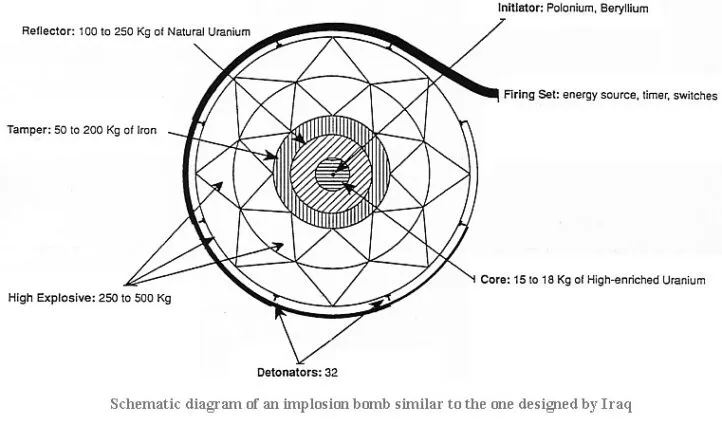
The entire purpose of these precision-engineered components and the manner in which they are configured within the device is to facilitate incredible levels of simultaneity. That is, at the instant of detonation, these explosives must ignite simultaneously to within nanoseconds, generating a perfectly spherical shock wave that compresses the pit of weapons grade uranium inward. Indeed, the necessary implosion needs to be so powerful that the uranium is squeezed to densities two to three times that of lead.
In turn, squeezing the pit to the requisite densities requires pressures reaching tens of millions of atmospheres. For purposes of comprehension these extreme pressures might be compared to the pressures in a standard automobile tire, which are generally at 2 to 3 atmospheres, not millions.
At the same time, the material is heated to millions of degrees in a fleeting instant. Yet any asymmetry in either the pressures or heating, even on the scale of a human hair, can distort the shock wave, thereby causing the “pit” to squirt out unevenly, and the device to “fizzle,” producing at best a low-yield dud or nothing at all.
The entire process must be timed with sub-microsecond precision, while the device must also remain safe and stable during transport, storage, and launch.
Moreover, even if Iran possessed the necessary high-explosive components and pit metallurgy today, it would still face yet another weaponization hurdle: To wit, the neutron-initiator problem.
The latter sits inside the hollow center of the spherical fissile pit. It is completely surrounded by the weapons-grade uranium. A reliable neutron initiator must flood the compressed pit with neutrons at the precise moment of maximum compression, which would be coming at the pit from the explosive detonators on the outer rim of the bomb.
Producing and integrating these components at industrial scale while maintaining safety and reliability is a non-trivial enterprise, obviously. In this context, US intelligence believes that Iran has conducted some modeling and small-scale experiments, but scaling to a functional warhead requires years of iterative design, subcritical hydrodynamic testing, and computer simulation validated against real data.
Miniaturization and survivability add another layer of difficulty. A crude device weighing hundreds of kilograms might be transportable by truck or ship. But a deliverable weapon that can be mated to a ballistic missile, survive re-entry heating and vibration, and detonate reliably at the intended altitude—usually 1,500 to 2,500 feet for anti-city applications – requires dramatic size and weight reduction and configuration.
And lest there be any confusion here – we are talking about an anti-city weapon designed to kill hundreds of thousands of civilians. After all, that’s what the supposed Iranian nuke threat is all about. In this regard, the only other nuclear attacks on cities were –
- the Little Boy bomb detonated at Hiroshima at 1,900 feet.
- the Fat Man bomb detonated at Nagasaki at 1,650 feet.
In any event, the problems of bomb/missile mating and sufficient miniaturization of the former are not trivial. North Korea’s first nuclear devices were too large for its missiles. So it took them years of additional work to miniaturize and compact their warheads to usable scale.
In this context, even Iran’s best current missiles are not fit for purpose. Thus, Iran’s Shahab-3 and Sejjil missiles have significant payload limitations that make them poorly suited for delivering a nuclear weapon. The Shahab-3, Iran’s longest-range operational ballistic missile, has a payload capacity of only about 700–1,000 kg, while the more advanced solid-fueled Sejjil offers roughly 700–1,200 kg.
By contrast, a first-generation nuclear warhead — including the heavy physics package, tamper, explosives, arming and fuzing systems, and re-entry vehicle protection — would likely weigh upwards of 1,500 kg. This means Iran would need to significantly miniaturize any nuclear device before it could be realistically mated to these missiles, which is a complex engineering challenge that has so far eluded them, as well.
In addition, the re-entry vehicle must protect delicate electronics and explosives from extreme thermal and mechanical stresses. Integrating the physics package into such a vehicle while preserving the precise timing required for an implosion is a separate engineering discipline that Iran has never demonstrated, either.
Perhaps the greatest single barrier, however, is testing and confidence. No nuclear weapon state has ever fielded an operational arsenal without some form of full-yield or near-full-yield testing.
That’s because the empirical data from actual detonations are irreplaceable. Computer models and subcritical experiments can only approximate reality. Accordingly, here is the applicable historical record:
- United States: 1,054 nuclear tests (1945–1992)
- Soviet Union/Russia: 715 nuclear tests (1949–1990)
- France: 210 nuclear tests (1960–1996)
- United Kingdom: 45 nuclear tests (1952–1991)
- China: 45 nuclear tests (1964–1996)
- India: 6 announced tests (1974 and 1998)
- Pakistan: 6 announced tests (1998)
- North Korea: 6 announced tests (2006–2017)
- South Africa: 0 tests (it built six gun-type devices in the 1980s but dismantled the program without ever detonating one).
Iran, by contrast, has perforce conducted zero nuclear tests because it has never even weaponized a bomb!
The alternative of proxy testing – using conventional explosives to mimic implosion dynamics – can provide useful data, but it cannot replicate the extreme pressures and neutron fluxes of an actual nuclear detonation.
Needless to say, therefore, the absence of any detected full-scale test or credible proxy program since 2003 remains a central pillar of the U.S. intelligence community’s long-standing judgment that Iran has conducted no weaponization activities.
Tulsi Gabbard’s aforementioned March 25–26, 2025, testimony to the House and Senate intelligence committees reaffirmed this crucial consensus in explicit terms. As Director of National Intelligence, she stated that
“the IC continues to assess that Iran is not building a nuclear weapon and Supreme Leader Khamenei has not authorized the nuclear weapons program that he suspended in 2003.”
She noted the unprecedented size of Iran’s enriched-uranium stockpile but drew a clear line between material production and weaponization. Gabbard’s remarks aligned with the unclassified 2025 Annual Threat Assessment, which highlighted Iran’s enrichment progress while underscoring the absence of resumed weapons-design activities.
In short, the 409 kilograms of 60 percent material that has so alarmed the warmongers because it could be upgraded to weapons-grade in weeks was the Ultimate False Flag.
There was never, ever any prospect of an “imminent” nuclear attack on US territory. Full Stop.
The truth is, when the Donald recklessly launched an all-out war on Iran it had no weaponized nuclear device; it had no long-range missile with a heavy payload (over 1,000 Kg) that could get even one-fifth of the way to Washington DC; and had no capability to marry a bomb, which it didn’t have, to a 5,000 kilometer range ICBM, which it didn’t have, either.
The implications of this discussion are uncomfortable in the extreme. They mean that Bibi, the Donald and his war cabinet of neocons, know-nothings and gym rats are operating on the basis of a blatant False Flag that makes all others that have gone before pale in significance.
At the end of the day, the conflation of enrichment processes with bomb-making capacitydefies even the working knowledge of the Washing War Machine itself.
Given the military mayhem it has already engendered and the far worse impending catastrophes of the ground force invasion just around the corner, it can therefore be well and truly said: Donald Trump is fixing to blow-up the global economy based on a Big Lie that anyone actually capable of making a nuclear bomb would recognize as utterly bogus, and instantly so.
The truth of the matter is this: We doubt whether the Donald—who does no homework and reads no briefs on even the daily trivia of governance to say nothing about subjects as complex and information deep as the Iranian nuke matter – has any clue that he has launched a devastating war for no good reason of Homeland Security whatsoever.
But there are a lot of people in Washington – and most especially denizens of the War Machine – who surely do. But the man has become so irrationally obsessed with his own ego-driven need to prevail at any cost that he is single-handedly ignoring all the contrary knowledge on the banks of the Potomac and is thereby stumbling into the worst kind of reckless belligerence ever contemplated by a US president.
In the next 24 hours, yet another Trumpian lapse into TACO man may save the day. But enough is enough. It’s time to call in the men in white coats and trigger the 25th Amendment, which was enacted to cope with the very circumstance at hand.
In this context, we are reminded of the fable about the mice who concluded that if they could just put a bell around the cat’s neck, they would all be henceforth safe. Alas, no mouse volunteered for the task, but in this case the gods of history are calling out the order quite clearly: JD Vance – you’ve got the Conn.
https://original.antiwar.com/david_stockman/2026/04/06/time-for-the-white-jacket-men/
posted by Satish Sharma at
16:22


0 Comments:
Post a Comment
Subscribe to Post Comments [Atom]
<< Home