Fighting the Eighth Front: Israel’s Information War
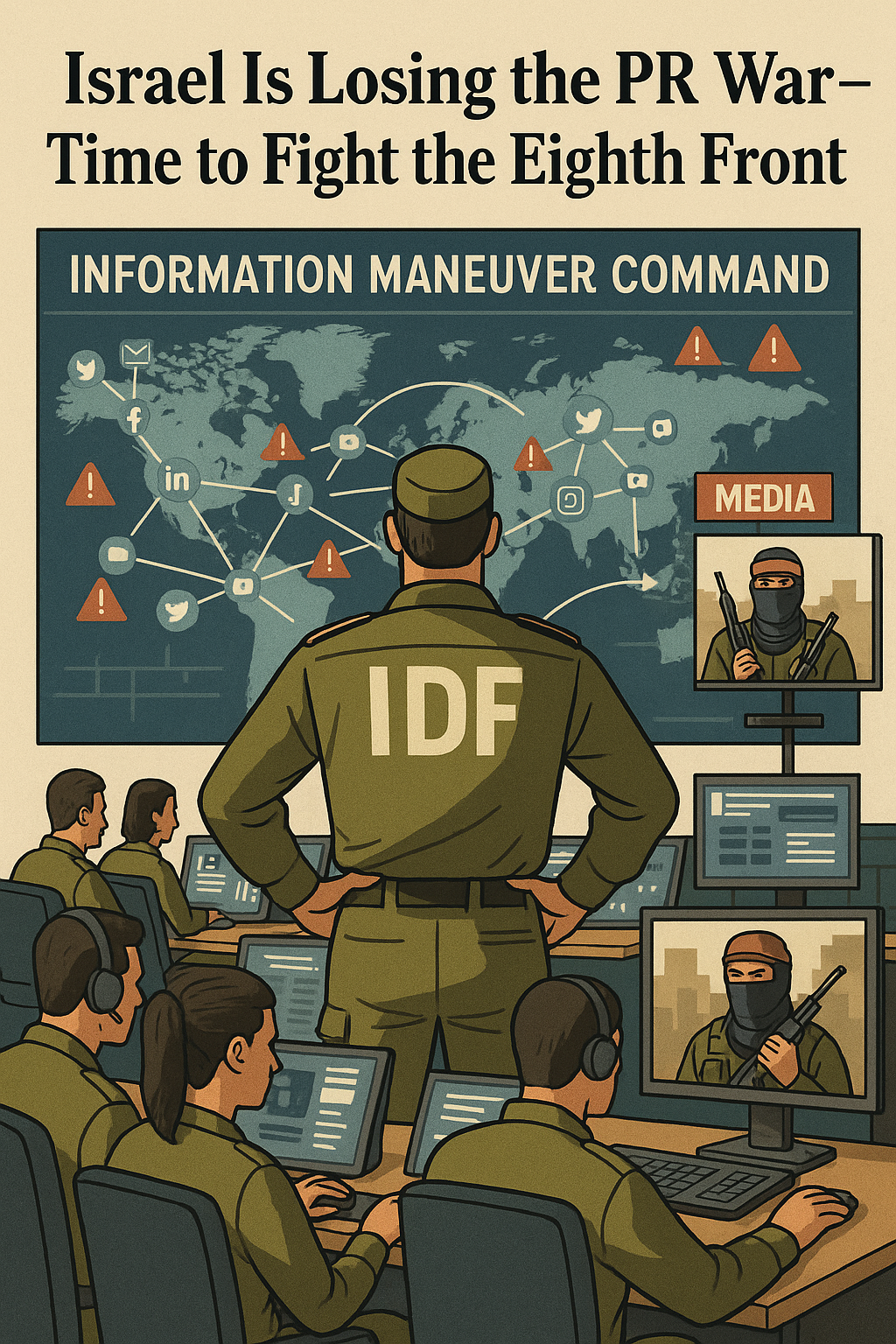
Donald Trump said it plainly this week: Israel is “not winning the world of public relations.” Whether you agree with the messenger or not, the message is true. Israel wins battles on the ground, in the air, and in cyberspace. Yet on the information battlefield, Israel too often shows up late, fragmented, or silent — while Hamas seizes the initiative.
For years, Hamas built a propaganda army:
- 1,500 media operatives — twice the manpower of the Israel Defense Forces’ media wing.
- 1,000 “combat cameramen” embedded with fighters, equipped with GoPros and live feeds.
- Editing rooms churning out clips within minutes.
- Hostage videos staged with chilling theatrical precision.
Nothing was released without Abu Obeida’s approval. He wasn’t just a spokesman — he was the general of Hamas’s perception war machine. His elimination this month silenced a voice, but not the method.
The question is whether Israel will finally recognize what Hamas understood all along: you cannot win the physical war and lose the information war.
Israel Already Has Pieces — But They’re Fragmented:
Israel is not starting from zero. The parts exist — but the hub does not.
- IDF Spokesperson’s Unit (Dover Tzahal): professional, respected, but too small for today’s nonstop media tempo.
- Military Censor: critical for protecting national security, but its clearance process is slow and often leaves a vacuum for adversaries to fill with falsehoods.
- National Public Diplomacy Directorate (Prime Minister’s Office) and Government Press Office: coordinate messaging and press logistics, but operate at ministerial pace, not at the speed of social media.
- Ministry of Foreign Affairs digital diplomacy: active through embassies and consulates, but without integrated intelligence feeds.
- Aman and Unit 8200 (Military Intelligence): unparalleled signals and cyber intelligence, but not designed for real-time publication.
- Shin Bet (Israel Security Agency) and Mossad: top-tier domestic and foreign intelligence, but not configured for rapid public communication.
- Israel Police and Yamam (elite counterterrorism unit): provide domestic counter-terror updates, but often siloed from the national message.
- First responders and hospitals — Magen David Adom (MDA), United Hatzalah, Hadassah, Ichilov, Rambam, Soroka: first on the scene, holding critical casualty and humanitarian data, but rarely integrated systematically into fast, public evidence releases.
Each of these bodies has strengths. But without a unifying hub, their efforts are fragmented, reactive, and easily outpaced by Hamas’s centralized propaganda system.
The Solution: An Information Maneuver Command:
Israel needs a new command that treats the information environment as seriously as the air force or cyber command: an Information Maneuver Command.
Mission: Gain the upper hand in the global information environment by detecting falsehoods quickly, proving the facts with evidence, and publishing them immediately — lawfully and credibly.
Commander: A Major General reporting directly to the Chief of Staff of the Israel Defense Forces.
Joint Council: Representatives from Military Intelligence (Aman and Unit 8200), Shin Bet, Mossad, the Israel Police, the Yamam counterterrorism unit, the IDF Spokesperson’s Unit, the Government Press Office, the Ministry of Foreign Affairs, and first responder organizations like Magen David Adom and United Hatzalah.
The Seven Brigades of the IMC:
1. Sensing and Intelligence Brigade (about 100 staff): Monitors social media in real time and fuses inputs from Unit 8200, Aman, Shin Bet, Mossad, Combat Intelligence, and other feeds. Produces a live “information map” of what is trending, where, and by whom.
2. Evidence and Disclosure Brigade (about 120 staff): Builds evidence packets: before-and-after satellite images, ground footage, verified casualty numbers from Magen David Adom and hospitals, and humanitarian context. The target is credible proof released within 60 minutes of a major incident.
3. Narrative and Creative Brigade (about 80 staff): Turns evidence into clear, human stories: subtitled videos, infographics, and explanatory posts in Hebrew, Arabic, English, French, Spanish, Russian, Persian, and Turkish. Also produces “pre-bunking” content that educates audiences about common manipulation tactics before they appear.
4. Platform and Policy Brigade (about 90 staff):
- Platform Liaison Group: permanent duty officers for Meta, X, YouTube, TikTok, Telegram, and other networks. Maintains direct lines, drills quarterly, and uses international mechanisms like the European Union’s Digital Services Act for crisis responsiveness.
- Press and Standards Liaison Group: owns long-term relationships with editors at Associated Press, Reuters, BBC, New York Times, Wall Street Journal, Fox, MSNBC, Sky, and others. Runs a verified “Editor Signal” bulletin that pushes evidence packets directly to newsrooms with callback numbers and update clocks.
5. Engagement and Community Brigade (about 70 staff): Mobilizes diaspora communities, campus advocates, influencers, and consulate-linked networks to push facts into key conversations.
6. Rapid Response and Rumor Control Brigade (about 60 staff): A crisis cell of analysts, lawyers, and creatives working together. Their goal: verify or rebut a major rumor within 15 minutes and deliver credible proof within one hour.
7. Training and Reserve Brigade (about 80 full-time staff plus 2,000 reservists): Draws from veterans of intelligence, media professionals, translators, academics, and legal experts. Runs adversary simulations, keeps doctrine updated, and provides surge manpower when needed.
A Proactive Posture — Relationships, Not Just Reactions:
The IMC cannot just wait for crises. Its analysts and liaisons must be proactive every day:
- Platform captains: each social media platform has an assigned officer with direct trust and safety contacts, tested regularly.
- Bureau captains: individual editors at Associated Press, Reuters, AFP, BBC, CNN, Fox, MSNBC, New York Times, Wall Street Journal, and regional outlets are kept “warm” through ongoing interaction.
- First responder desks: permanent links to Magen David Adom, United Hatzalah, and hospitals to provide rapid casualty and humanitarian confirmation.
- Regional desks: Americas, Europe, Middle East/North Africa, Asia-Pacific — ensuring global time-zone coverage.
Proactive tactics include:
- Pre-briefing editors on how Israeli evidence is sourced and cleared.
- Regular “standards clinics” with newsroom fact-checkers.
- Explainer kits on humanitarian safeguards, pre-cleared and embargoed for quick release.
- Pre-bunking videos teaching audiences how manipulation works.
- Vetted creators with strict provenance rules, paired with newsroom packets.
This ensures that when a crisis breaks, Israel is not cold-calling strangers — it is calling trusted partners who know the process.
How It Works in Practice:
Scenario: A hospital explosion in Gaza.
- The Sensing and Intelligence Brigade flags the spike immediately.
- The Rapid Response Brigade starts the rumor verification clock.
- The Evidence and Disclosure Brigade assembles satellite images, geolocation, strike rationale, casualty confirmations from the Red Cross and hospitals, and humanitarian steps.
- The Spokesperson’s Unit and the Military Censor clear the release.
- The Platform and Policy Brigade pushes evidence simultaneously to platforms (for authenticity labeling and takedowns of manipulated media) and to editors (via Editor Signal).
- The Narrative and Creative Brigade publishes human-clear explainers.
- The Engagement Brigade amplifies through communities and influencers.
Result: Instead of silence or denial, Israel provides proof first. Editors and platforms see receipts before adversaries can set the narrative.
Guardrails — Protecting Trust:
- Evidence before adjectives. If facts aren’t ready, say what checks are happening and when the next update will come.
- Lawful speed. Work with the Military Censor to clear information quickly without compromising security.
- No weak claims. Expedient spin erodes credibility.
Measuring Success in Plain English:
Success would be tracked by clear, understandable metrics:
- How fast can a rumor be addressed? (Target: 15 minutes for major incidents.)
- How fast can evidence be published? (Target: within one hour.)
- How widely is Israel’s framing shared among neutral audiences?
- How quickly does Israel’s version become the leading narrative in major outlets?
- How many editors use IMC packets within the first six hours of an incident?
- How responsive are platforms, measured by logged request and resolution times?
- How fresh are our contact lists with editors and platforms? (Goal: verified every 30 days.)
A 90-Day Stand-Up Plan:
- Days 0–30: Appoint a commander, seat the joint council, embed Military Censor officers in the war-room, launch Editor Signal, open platform hotlines.
- Days 31–60: Bring the evidence pipeline online, preload 50 ready-to-use storybanks, brief editors worldwide, wire Magen David Adom and hospitals directly into feeds.
- Days 61–90: Run an adversary red-team simulation, publish a transparency annex showing what requests were made to platforms and what responses came back, and adjust doctrine.
Why This Matters:
Israel already has spokes — the Spokesperson’s Unit, the Military Censor, the intelligence agencies, the police, the GPO, the MFA, Magen David Adom, United Hatzalah, hospitals — but no hub. Hamas has a hub.
The Information Maneuver Command would be that hub: a combat command for the information front. It ensures that when Hamas floods Telegram, Israel floods newsrooms with proof. It ensures that editors, platforms, and publics see Israel’s evidence first.
Israel is unmatched in tanks, jets, and cyber units. Now it needs an army for perception — built on truth, structured for speed, and resourced to win.
Because if Israel continues to win the physical war but lose the information war, the strategic outcome may still be defeat.
It’s time to fight the eighth front like we intend to win it.
https://blogs.timesofisrael.com/fighting-the-eighth-front-israels-information-war/
posted by Satish Sharma at
08:09


0 Comments:
Post a Comment
Subscribe to Post Comments [Atom]
<< Home