Russia and China are sending Biden a message: don’t judge us or try to change us. Those days are over
Emeritus Fellow, Australian National University
The past week has marked a watershed moment in Russia’s relations with the West — and the US in particular. In two dramatic, televised moments, US President Joe Biden and Russian President Vladimir Putin have changed the dynamics between
China pushing back against the US, too
Putin’s forceful statement is remarkably similar to the equally firm public statements made by senior Chinese diplomats to US Secretary of State Antony Blinken in Alaska last week.
Blinken opened the meeting by lambasting China’s increasing authoritarianism and aggressiveness at home and abroad - in Tibet, Xinjiang, Hong Kong and the South China Sea. He claimed such conduct was threatening “the rules-based order that maintains global stability”.
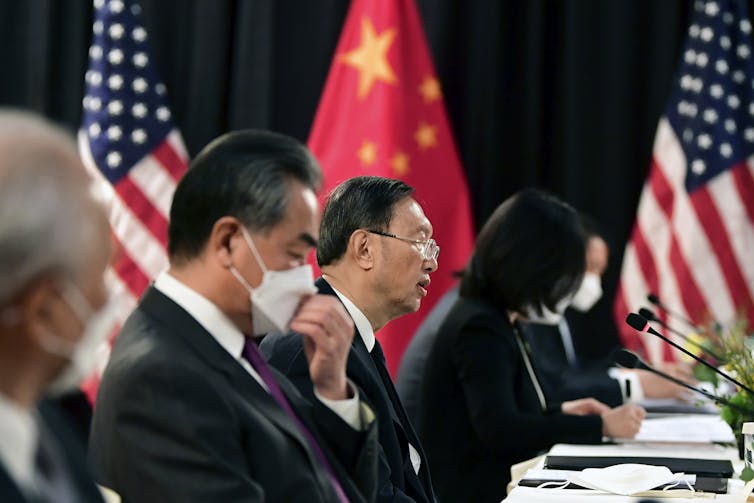
Yang Jiechi, Chinese Communist Party foreign affairs chief, responded by denouncing American hypocrisy. He said
The US does not have the qualification to say that it wants to speak to China from a position of strength. The US uses its military force and financial hegemony to carry out long-arm jurisdiction and suppress other countries. It abuses so-called notions of national security to obstruct normal trade exchanges, and to incite some countries to attack China.
He said the US had no right to push its own version of democracy when it was dealing with so much discontent and human rights problems at home.
Russia and China drawing closer together
Putin’s statement was given added weight by two diplomatic actions: Russia’s recalling of its ambassador in the US, and Foreign Minister Sergey Lavrov’s meeting in China with his counterpart, Wang Yi.
Beijing and Moscow agreed at the summit to stand firm against Western sanctions and boost ties between their countries to reduce their dependence on the US dollar in international trade and settlements. Lavrov also said,
We both believe the US has a destabilising role. It relies on Cold War military alliances and is trying to set up new alliances to undermine the world order.
Though Biden’s undiplomatic comments about Putin may have been unscripted, the impact has nonetheless been profound. Together with the harsh tone of the US-China foreign ministers meeting in Alaska — also provoked by the US side — it is clear there has been a major change in the atmosphere of US-China-Russia relations.
What will this mean in practice? Both Russia and China are signalling they will only deal with the West where and when it suits them. Sanctions no longer worry them.
The two powers are also showing they are increasingly comfortable working together as close partners, if not yet military allies. They will step up their cooperation in areas where they have mutual interests and the development of alternatives to the Western-dominated trade and payments systems.
Countries in Asia and further afield are closely watching the development of this alternative international order, led by Moscow and Beijing. And they can also recognise the signs of increasing US economic and political decline.
It is a new kind of Cold War, but not one based on ideology like the first incarnation. It is a war for international legitimacy, a struggle for hearts and minds and money in the very large part of the world not aligned to the US or NATO.
The US and its allies will continue to operate under their narrative, while Russia and China will push their competing narrative. This was made crystal clear over these past few dramatic days of major power diplomacy.
The global balance of power is shifting, and for many nations, the smart money might be on Russia and China now.
https://theconversation.com/russia-and-china-are-sending-biden-a-message-dont-judge-us-or-try-to-change-us-those-days-are-over-157771
posted by Satish Sharma at
05:17


0 Comments:
Post a Comment
Subscribe to Post Comments [Atom]
<< Home