Reveal About Gov’t Surveillance Of Muhammad Ali
President Obama praised the late athlete and activist
as a ‘powerful force for peace and reconciliation
around the world,’ but what he didn’t mention was
the government’s pervasive surveillance of Ali’s life.
As the world mourns a man that many consider one of the greatest and most
influential sports figures of all time, the president and other current and
former government officials were eager to memorialize Ali.
Ali was “not just as skilled a poet on the mic as he was a fighter in the ring, but a
“Later, as his physical powers ebbed, he became an even more powerful force
for peace and reconciliation around the world,” he added.
An Olympic gold medal-winning boxer, Ali won the world heavyweight
boxing title on three separate occasions. But his actions outside the ring as
an activist for equal rights for oppressed minorities and an opponent of
U.S. imperialism brought him as much or even more fame and notoriety.
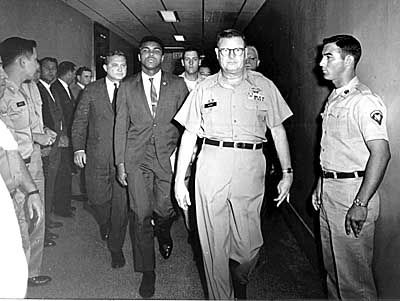
He was arrested in 1967 for resisting the Vietnam War draft, resulting
in a lengthy legal battle and the suspension of his boxing license during three
of the peak years of his career.
Ali famously spoke out against what he saw as the racist origins of the Vietnam
War and U.S. empire-building, saying in 1967:
”Why should they ask me to put on a uniform and go 10,000 miles
from home and drop bombs and bullets on Brown people in Vietnam
while so-called Negro people in Louisville are treated like dogs and denied
simple human rights? No I’m not going 10,000 miles from home to help
murder and burn another poor nation simply to continue the domination
of white slave masters of the darker people the world over.”
Although widely regarded as an inspirational American sports legend, the
U.S. government monitored Ali as it did so many other critics of foreign
and domestic policy, treating him much like it has treated suspected enemies
of the state.
broke into an FBI office in Media, Pennsylvania, taking advantage of the
excitement over Ali’s fight with Joe Frazier to provide cover for their operation.
The files they stole revealed that the FBI was keeping tabs on Ali, among many
on Monday, called “poetic justice”:
“As more and more secret FBI files became public as a result of the break-in,
it was revealed that the FBI had kept tabs on Ali, beginning with its i
nvestigation of his Selective Service case. Some of his phone conversations
were tapped, and FBI informers gained access to, of all things, his
elementary school records in Louisville (teachers said little Cassius Clay,
his original name, loved art). Informers also had diligently monitored and
typed, word for word, what Ali said on his appearances on the Tonight Show
with Johnny Carson.”
Formerly top secret documents revealed in 2013 by a lawsuit also showed that
Ali was monitored on an NSA watchlist which included journalists and other
racial justice activists like Dr. Martin Luther King, Jr.
“The surveillance was justified as necessary to identify ‘domestic terrorist and
have been directed primarily at eavesdropping on government critics
—opponents
of the Vietnam War, for instance, such as Sen. Frank Church,
D-Idaho,
Whitney Young, and Muhammad Ali.”
As news of Ali’s death spread this week, WikiLeaks shared its own contribution
to the discussion:
The 17 Hillary Clinton emails that reference Mohammed Alisearch.wikileaks.org/?query=%22muha… … #mohammedali#muhammadali
More:search.wikileaks.org/?query=%22muha…

WikiLeaks archives — in particular, its Public Library of U.S. Diplomacy, a collection
of decades of cables from U.S. embassies and ambassadors — show the
also shows that Ali’s actions sometimes coincided with U.S. government interests,
The most shocking details may be forthcoming. Because his death means his
entire FBI file could soon be released to the public, it’s likely that more
information about government surveillance of “The Greatest of All Time”
will soon come to light:

‘The Real Enemy of My People is Right Here’” from Democracy Now!:
http://www.mintpressnews.com/fbi-office-break-wikileaks-reveal-govt-surveillance-muhammad-ali/217065/
posted by Satish Sharma at
09:56


0 Comments:
Post a Comment
Subscribe to Post Comments [Atom]
<< Home