Tuesday, 31 March 2015
by Jason Ditz,
Saudi warplanes attacked the al-Mazzrak refugee camp in Yemen’s Hajjah Province today, killing at least 45 civilians and wounding some 200 others, according to aid workers on the ground.
Saudi officials were quick to deny responsibility for the killings, and declared that the Houthis they are at war with inexplicably attacked the camp. This was in spite of Saudi officials bragging only yesterday they’d destroyed every warplane in Yemen.
Doctors Without Borders and other aid groups confirmed that the attack was indeed an airstrike, and there seems no serious doubt it was a Saudi strike, just the latest in an air campaign that is increasingly targeting civilians.
The Saudis began attacking Yemen last week, promising to reinstall Abd Rabbu Mansour Hadi as ruler, after Hadi resigned in January and fled the country. Some 150,000 Saudi troops are massed at the border, though the timing of a ground invasion remains unclear.
http://news.antiwar.com/2015/03/30/saudi-airstrikes-hit-yemen-refugee-camp-45-civilians-killed/
End of Israeli ‘Nuclear Ambiguity’ Good For Peace
An Israeli-conceived, U.S.-enforced farce masquerading as "grand strategy" is finally dead. For years the Israeli government refused to confirm or deny its nuclear weapons program. The February release of the Israeli section of the Defense Department-commissioned report "Critical Technology Assessment in Israel and Nation Nations" (PDF) killed off the policy while setting off an Internet conflagration last week (the most vicious unfolding over Twitter). At one side of the political spectrum, the document’s release was evidence of "a shocking breach" by the Obama administration and betrayal of Israel by some media outlets for even reporting it. At the other it revealed a "highly successful partnership of American and military science" despite zero evidence the U.S. intended such "Atoms for Peace" gifts as Israel’s Soreq nuclear reactor to be used for anything but peaceful purposes.
The five tragedies of "ambiguity" and benefits to be gained by its demise are only slowly emerging from the rubble.
- Ambiguity was premised on presidential fear of the Israel lobby. The history of so-called "ambiguity" is sordid, which is why it was classified for decades. Until the very end, JFK waged a two-front battle against Israel going nuclear and the undue influence of the Israel lobby. Both the LBJ and Nixon administrations considered withholding conventional military aid in order to keep Israel from going nuclear. In the end, fear of Israel’s US lobby, rather than any legitimate US national security concern, was the linchpin of "ambiguity." As recently declassified administration papers put it, fears of a “Zionist campaign to try to undermine“(PDF) Nixon encouraged him to sign America on.
- American presidents lied about Israel. As Professor John Mearsheimer once characterized it, the key question to ask about Israel’s opacity policy was, "who are you fooling?" No Middle East national leader or Western elite ever doubted Israel has nuclear weapons. A statistically significant poll last year reveals that the majority of American adults believe Israel has nuclear weapons. Since nobody is actually fooled by so-called, "ambiguity," compliance by US presidents must have been for some other important purposes. Presently, only a few understand how abusive the policy truly was to non-proliferation, taxpayers and the rule of law.
- Nonproliferation undermined. The premise of many self-appointed proliferation experts has been that "ambiguity" reduced nuclear proliferation. They point to the fact of Saudi Arabia and Egypt not going nuclear as an outcome of Israel’s not opening flaunting its nuclear arsenal. Yet proliferation did occur, from Israel, and from the US to Israel.
- Skewed information, skewed debate. The US government gags federal workers, under threat of prosecution, from honestly discussing Israel’s nuclear arsenal. In elite media, the current US debate about nuclear proliferation in the Middle East focuses almost entirely on Iran, a non-nuclear weapons holding signatory to the NNPT. Israeli journalists and foreign correspondents in Israel are gagged by military censors from discussing Israel’s nukes. Elite media networks are beholden to the US government policy due to their need to maintain "access" to sources. But journalists also, as reported in the Washington Post, felt the need not to "out friends."
- US taxpayers defrauded. Beyond flouting the NNPT, what is the other real reason Israel, its US lobbying organizations like AIPAC, and presidents have been content to promote and maintain an ambiguity policy nobody actually believed in? Money. All US aid to Israel since 1976 has been delivered in direct violation of theSymington and Glenn Amendments to the Foreign Assistance Act of 1961 which forbids US aid to nuclear states outside NNPT. By publicly pretending it could not "speculate" about or know the status of the arsenal, the presidential ambiguity policy has been used to violate these important nonproliferation laws. The end victim has been the US taxpayer who, adjusting for inflation, shelled out $234 billion in illegal aid to Israel since 1976.
There is credible evidence that Israel offered South Africa’s apartheid regime nuclear weapons and know-how, a harsh blow to the Nuclear Nonproliferation Treaty. Worse still, by purloining material, technology and know-how from the United States, which then usually abstains from enforcing its own export control laws and the Atomic Energy Act, Israel’s program puts the US in violation of the NNPT.
US taxpayers, all 122 million of them, should immediately (or at least before April 15) begin looking for ways to claim their $1,910 average credit for unlawful taxes transferred to nuclear Israel. It is now the Federal government’s problem figuring out how to "claw back" that illegal aid.
The establishment news media, after recognizing its many decades of failure, should now begin asking the real questions. The first and most obvious is, "precisely who does Israel target with its arsenal of hydrogen bombs?" Are such weapons aimed at regional rivals dominated by Israel’s conventional superiority – or more plausibly – coercing major power support for other policies just as dubious and harmful as "ambiguity"?
http://original.antiwar.com/smith-grant/2015/03/30/end-of-israeli-nuclear-ambiguity-good-for-peace/
America's 'Death Instinct' Spreads Misery Across the World
Those who use violence to shape the world, as we have done in the Middle East, unleash a whirlwind. Our initial alliances—achieved at the cost of hundreds of thousands of dead, some $3 trillion in expenditures and the ravaging of infrastructure across the region—have been turned upside down by the cataclysm of violence. Thirteen years of war, and the rise of enemies we did not expect, have transformed Hezbollah fighters inside Syria, along with Iran, into our tacit allies. We are intervening in the Syrian civil war to assist a regime we sought to overthrow. We promised to save Iraq and now help to dismember it. We have delivered Afghanistan to drug cartels and warlords who preside over a ruin of a nation where 60 percent of the children are malnourished and the Taliban is poised to take power once NATO troops depart. The entire misguided enterprise has been a fiasco of gross mismanagement and wanton bloodletting. But that does not mean it will be stopped.
More violence is not going to rectify the damage. Indeed, it will make it worse. But violence is all we know. Violence is the habitual response by the state to every dilemma. War, like much of modern bureaucracy, has become an impersonal and unquestioned mechanism to perpetuate American power. It has its own internal momentum. There may be a few courageous souls who rise up within the apparatus to protest war’s ultimate absurdity, but they are rapidly discarded and replaced. The state rages like an insane King Lear, who in his madness and desire to revenge himself on his two daughters and their husbands decides that:
It were a delicate stratagem to shoe
A troop of horse with felt. I’ll put ’t in proof.
And when I have stol’n upon these sons-in-law,
Then, kill, kill, kill, kill, kill, kill!
And kill, kill, kill, kill, kill, kill is the mantra chanted with every new setback in the Middle East. How many times have we rejoiced at the murder of those we demonized—Saddam Hussein, Osama bin Laden, Abu Musab al-Zarqawi and dozens of others. But as soon as one hunt for the fountainhead of evil ends, another begins. Those we kill are swiftly replaced. Fresh terrorist groups take the place of the old. TheKhorasan Group, the U.S. government assures us, is a more sinister and deadlier version of the Islamic State of Iraq and Greater Syria (ISIS), which was once touted as a more sinister version of al-Qaida. We cannot extinguish our enemies. They spring out of the ground like the legion of hostile warriors that rose up when Cadmussowed his dragon’s teeth. Our violence spawns violence and never-ending configurations of enraged militants. We will keep spawning them until we stop occupying the Middle East.
Endless war, which results in endless terror, leaves the arms manufacturers and generals giddy with joy. It is a boon to the state, which is possessed of an excuse to extinguish what few liberties we have left. It fuels the militancy and hatred that fanatics need to justify their slaughter and attract recruits. But it is a curse to humankind.
The barbarism of modern industrial warfare creates complex bureaucratic mechanisms that exist to perpetuate and manufacture death. We are hostages to those mechanisms. “The soul that is enslaved to war cries out for deliverance,” Simone Weil observed, “but deliverance itself appears to it an extreme and tragic aspect, the aspect of destruction.”
“Thus war effaces all conceptions of purpose or goal, including even its own ‘war aims,’ ” she wrote. “It effaces the very notion of war’s being brought to an end. Consequently, nobody does anything to bring this end about. In the presence of an armed enemy, what hand can relinquish its weapon? The mind ought to find a way out, but the mind has lost all capacity to so much as look outward. The mind is completely absorbed in doing itself violence. Always in human life, whether war or slavery is in question, intolerable sufferings continue, as it were, by the force of their own specific gravity, and so look to the outsider as though they deprived the sufferer of the resources which might serve to extricate him.”
Violence as a primary form of communication has become normalized. It is not politics by other means. It is politics. Democrats are as infected as Republicans. The war machine is impervious to election cycles. It bombs, kills, maims, tortures, terrorizes and destroys as if on autopilot. It dispenses with humans around the globe as if they were noisome insects. No one dares lift his or her voice to protest against a war policy that is visibly bankrupting the United States, has no hope of success and is going to end with new terrorist attacks on American soil. We have surrendered our political agency and our role as citizens to the masters of war.
“It seems to me that nearly the whole Anglo-Saxon race, especially of course in America, have lost the power to be individuals,” wrote the artist Roger Fry. “They have become social insects like bees or ants.”
Søren Kierkegaard in “The Present Age” warned that the modern state seeks to eradicate conscience and absorb individuals into a public that can be shaped and manipulated by those in power. This public is not real. It is, as Kierkegaard wrote, a “monstrous abstraction, an all-embracing something which is nothing, a mirage.” In short, we became part of a herd, “unreal individuals who never are and never can be united in an actual situation or organization—and yet are held together as a whole.” Those who question the public, those who denounce endless war, are dismissed as dreamers or freaks. But only they, according to the Greek definition of the polis, can be considered citizens.
In endless war it does not matter whom we fight. Endless war is not about winning battles or promoting a cause. It is an end in itself. In George Orwell’s novel “Nineteen Eighty-Four” Oceania is at war with Eurasia and allied with Eastasia. The alliance then suddenly is reversed. Eurasia becomes an ally of Oceania and Eastasia is the enemy. The point is not who is being fought. The point is maintaining a state of fear and the mass mobilization of the public. War and national security are used to justify the surrender of citizenship, the crushing of dissent and expanding the powers of the state. The point is war itself. And if the American state, once a sworn enemy of Hezbollah, gives air cover to Hezbollah fighters in Syria, the goals of endless war remain gloriously untouched.
But endless war is not sustainable. States that wage endless war inevitably collapse. They drain their treasuries, are hated by the wretched of the earth, and militarize and strangle their political, social and cultural life while impoverishing and repressing their populations. They are seduced by what Sigmund Freud called the “death instinct.” This is where we are headed. The only question is when it will unravel.
Edward Gibbon observed about the Roman Empire’s own lust for endless war: ” ... [T]he decline of Rome was the natural and inevitable effect of immoderate greatness. Prosperity ripened the principle of decay; the cause of the destruction multiplied with the extent of conquest; and, as soon as time or accident had removed the artificial supports, the stupendous fabric yielded to the pressure of its own weight. The story of the ruin is simple and obvious: and instead of inquiring why the Roman Empire was destroyed we should rather be surprised that it had subsisted for so long.”
Why the West is to Blame for the Crisis in Ukraine: The Full Story
We can't begin to understand the Ukrainian catastrophe unless we reject the dominant Western account of what is happening.
By Chris Nineham
WE ALL KNOW about of the fog of war, but the current coverage and commentary on the crisis in Ukraine arguably takes wartime disinformation to new levels.
Richard Sakwa's new book is a rare and precious exception. It is clear and measured and carefully researched and it shows that the story we are told in the west about events inside Ukraine is deeply flawed.
More generally, it exposes the idea that Russia is the aggressor and the West the protector of Ukraine's democratic will as a travesty of the truth. In short, Sakwa's analysis is diametrically opposed to what passes for an explanation of the Ukraine crisis in the mainstream.
One of the book's great strengths is that it sees the crisis as a product of two connected processes, one domestic, one geopolitical.
Far from being a straightforward expression of popular will, Sakwa details how the government that emerged from the Maidan protests in February 2014 represented the victory of a minority hardline anti-Russian Ukrainian nationalism.
But this minority could come to dominate, he argues, because of the context provided by an aggressive, US-led, Western foreign policy designed to assert Western control over Eastern Europe and, at least in its more hawkish versions, de-stabilise Russia.
The push to the east
Nato and the EU have been pushing steadily eastwards ever since the end of the Cold War, despite verbal assurances from a series of Western leaders that this would not happen.
Twelve countries have joined Nato in the region since 1991. Georgia and Ukraine were promised membership at the Nato Summit in Bucharest in 2008, despite repeated warnings from the Russian government that taking Nato to the Russian border would cause a security crisis of the first order. It was only the intercession of Germany and France that forced the US to put these plans on hold.
The push to the east continued in the form, amongst others, of a plan to get Ukraine to sign up to an 'Association Agreement' with the EU. It was this agreement, due to be signed in November 2013, which sparked the crisis. To grasp its significance it is important to understand just how closely tied Nato and the EU have become, especially since the Lisbon Treaty signed by EU members in 2007.
Article 4 in the proposed Association Agreement committed the signatories to 'gradual convergence on foreign and security matters with the aim of Ukraine's ever deeper involvement in the European Security area' (p.76). As Sakwa puts it, “it is pure hypocrisy to argue that the EU is little more than an extended trading bloc: after Lisbon, it was institutionally a core part of the Atlantic security community, and had thus become geopolitical”. (p.255)
All parties involved must have known that this document, if signed, would have caused existential anxiety in Moscow. Defenders of the West's drive to the east justify it as the reflection of the will of the people concerned.
This is disingenuous. As Western leaders themselves have publicly admitted, a campaign to buy Ukrainain hearts and minds has been running for decades. In 2013, US Assistant Secretary of State for European and Eurasian affairs, Victoria Nuland, publicly boasted of the fact that the US had invested $5 billion in 'democracy promotion' since 1991, a huge sum by USAID's standards (p.86). It has since been revealed that the EU too spent 496 million on front groups in Ukraine between 2004 and 2013 (p.90).
And there was nothing democratic about the process. Discussions about the Association Agreement in fact took place behind the backs of the Ukrainian people and the text of the agreement was not available in Ukraine till the last moment (p.74). It actually contained very little in the way of assistance to Ukraine's economy, and its centrepiece was a radical liberalisation of EU-Ukraine trade, a direct threat to the traditional economic relations between Ukraine and Russia.
In the end, for a mixture of reasons, President Yanokovich didn't sign up to the deal. But the pressure to sign helped to polarise the debate in Ukraine. The meaning of the agreement was an open secret in Washington. In the words of Carl Gershman from the National Endowment for Democracy, while Ukraine was 'the biggest prize', there was, beyond that, an opportunity to put Putin 'on the losing end not just in the near abroad but within Russia itself'. (p.75)
Internal impact
This concerted Western strategy to surround and weaken Russia had a profound impact on the internal politics of Ukraine. Sakwa explains well the complex history that links Ukraine and Russia, a history that can't be reduced to simple formulas of colonial dependency. The long, indigenous tradition of seeing Ukraine as part of greater Russian union has resulted in Russian being the dominant language in most of the country despite ethnic Russians being a relatively small minority. (p.8)
For all the mixed motivations behind the Maidan protests, it was a hardline anti-Russian strand that came to dominate, first in the protests themselves and subsequently in the regime that emerged out of the forced removal of the Yanukovich government.
Western policy in general gave ballast to a hardline nationalist tradition in the country that saw Russia – and the Russian minorities within the country - as the enemies of Ukrainian nationalism.
This tradition centred on the historic figure of Stepan Bandera who collaborated with the German Nazis in atrocities against Jews, Poles and Russians in Ukraine during WW2. His followers formed SS divisions which were responsible for the deaths of up to half a million people. (pp16-17). A giant poster of Bandera hung by the side of the stage in the Maidan, and many leaders of the regime that came out of the Maidan saw him as part of their tradition.
The West was minutely involved in this process. The State Department's Victoria Nuland visited Ukraine three times in the first few weeks of the Maidan protests (p.86). The famous February leaked phone call between her and the US ambassador in Ukraine in which Nuland said 'fuck the EU', showed the extent to which the US was pulling the strings and in which direction.
In the call Nuland judges that the relatively moderate nationalist Vitaly Klitschko, who had the backing of Germany and the EU, should be kept out of office and that Arseniey Yatsenhuk – 'Yats' she calls him - a man who turned out to be a hardline chauvinist, should be the key player. Yatsenyuk indeed became the acting Prime Minister in the new government.
The result, in Sakwa's words, was that, 'what had begun as a movement in support of 'European values' now became a struggle to assert a monist representation of Ukrainian nationhood. The amorphous liberal rhetoric gave way to a much harsher agenda of integrated nationhood, and the euphoria promoted a rash of ill-considered policies' (p.94).
As President Yanukovich was impeached and the new government was installed, armed insurgents strutted around the debating chamber. Yatsenyuk's government was a mixture of recycled oligarchs and hard-line nationalists and fascists. It contained only two ministers from the entire south and east of the country, the areas with closest ties to Russia.
Five cabinet positions out of 21 were taken by the far right Svoboda Party, despite the fact they had only received 8% of the seats in Parliament. The minister of justice and the deputy Prime Minister came from the Russophobic Svobada party and its founder, a man with a long record of ultra nationalist activism, Andriy Parubiy, became head of the NSDC security agency.
Provocations
One of the new government's first acts was to vote to rescind a law guaranteeing the right to instate a second official language where there were significant minorities. Although the change in the law was blocked, the vote was correctly interpreted as an attack on Russian minorities across the country.
It was followed by the outlawing of the Ukrainian Communist Party and the establishment of a 'special service' to root out fifth columnists in the armed forces (p.137). A wave of physical assaults on Russians duly followed.
In Odessa, pro-Russian activists were driven from an encampment into a trade union building which was then torched, killing a minimum of 48, many hundreds according to locals. The massacre was hailed by one of the Maidan leaders, Dmytro Yarosh, as 'another bright day in our national history' (p.98).
This series of events made a civil war virtually inevitable. Uprisings in the east of the country were motivated by political resentments, opposition to neoliberal policies and other economic grievances against Kiev, but most of all by a sense of the need for self defence. Unlike the largely middle-class movement in Kiev, the anti-Maidan movement in the Donbass region was ‘lower-class, anti-oligarchic (and Russian nationalist)' (p.149). It was not mainly separatist. A poll by the Pew Research Center in May 2014 found that 70 per cent of eastern Ukrainians wanted to keep the country intact, including 58 per cent of Russian speakers (p.149).
The view from the East
Sakwa carefully analyses Russia's behaviour during the crisis. His conclusions are a frontal challenge to the West's narrative that the crisis in the Ukraine was precipitated by Russian aggression. As he shows, this is the opposite of the truth.
After the collapse of the Soviet Union, successive governments embraced a Western orientation, even making tentative moves to join Nato. In contrast to the stereotype that has been so carefully constructed, in his first term, Putin, and his successor Medvedev, sought engagement and accommodation with the West and tried to establish structured relationships with Nato and the EU.
This approach faltered according to Sakwa, because of repeated rebuffs from the West:
“Continued conflicts in the post-Soviet space, the inability to establish genuine relations with the EU and disappointment following Russia's positive demarche in its attempt to reboot relations with the US after 9/11 all combined to sour Putin's new realist project” p.31
Over the last decade and a half, the Russian foreign policy establishment has become more and more alarmed by the unilateralism of US foreign policy, particularly over the invasion of Iraq and the attack on Libya. The non-negotiated push eastwards by Nato and the EU could of course only be perceived as hostile.
Even in these circumstances, however, for Sakwa, Putin's central concern was to maintain the status quo in Ukraine, and try and ensure a friendly or at least neutral buffer state based on a stable settlement within the multi-ethnic Ukrainian state.
The forced, Western-backed removal of the Yanukovich government created an immediate crisis for the Russian government. Putin reacted by running a popular poll and an armed operation to secure the secession of the Crimean region to the USSR. Given the level of hostility and the mobilisations against Russian minorities, this can have surprised no-one. The Crimea was part of Russia until 1954, and it contains Sevastopol, Russia's only major warm-water naval base. The idea that the Russian ruling class was going to stand aside and allow this area to be taken by a pro-Nato and anti-Russian government was obvious fantasy.
But if Putin's long-term plan had been to invade, partition or even to destabilise the rest of Ukraine, he would have taken the opportunity presented by the virtual collapse of the Ukrainian government in February last year and the anti-Kiev uprisings in the east of the country which developed as a result.
His response was in fact was very different. Sakwa argues that despite the hoopla in the Western media, with the exception of the special case in Crimea, there is little evidence of significant military intervention by Russia in the months after the crisis of February, at least until August.
Putin supported the rebels to try and gain some leverage, but when it came to military assistance the rebels in the east were denouncing Putin for not delivering it. In Sakwa's words, “Russia used proxies in the Donbas to achieve its goals within Ukraine, but this was not an attempted 'land-grab' or even a challenge to the international system” (p.182).
On 24 June in fact, the Russian Federation Council revoked a ruling which had previously allowed Russian military involvement in Ukraine ‘in order to normalise and regulate the situation in the eastern regions of Ukraine' in the run up to tripartite talks involving the new Prime Minister Poroshenko (p.162). But Poroshenko had been the continuity candidate. On taking office, he had issued a statement calling for ‘a united, single Ukraine' and characterising insurgents in the south-east as 'terrorists' (p.161).
Sakwa, along with most other sane commentators, is far from idealising the authoritarian and sometimes aggressive Russian regime. He criticises its human rights record and its institutions of governance. If anything his instincts are with a reformed integrationist 'wider European project', which, given the behaviour of the actually-existing Western institutions, seems a bit of a forlorn hope.
But what Sakwa's book does so well is to ask us to go beyond rhetoric and generalities and examine the actual dynamics of the particular situation in its national and international dimensions.
Most importantly, he argues, we can't begin to understand the Ukrainian catastrophe unless we completely reject the dominant, not to say consensual, Western account of what is happening. This is a crisis created by the West, but by threatening Russia's core interests, it contains the possibility of a catastrophic confrontation; ‘the US has sought to create a regime in its own image, while Russia has sought to prevent the creation of one hostile to its perceived interests' he argues (p.255).
We in the West have a responsibility to do everything possible to force our leaders back from the brink.
Source: Stop the War Coalition
http://www.informationclearinghouse.info/article41399.htm
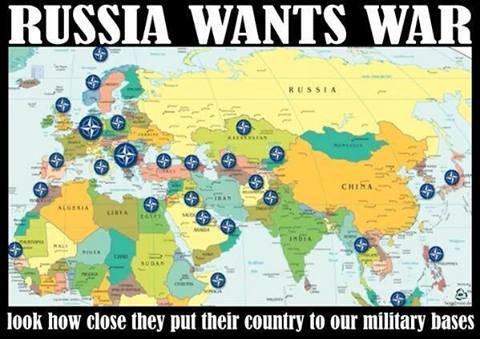
Proof that Russia and Iran Want War
By Washingtons Blog
Look How Close They Put Their Countries To Our Military Bases!
Proof!
Bad people are putting their countries closer and closer to our military bases:
Look how close Russia put its country to our military bases:
Iran is just as bad:
This proves that Russia and Iran are the bad guys!
http://www.informationclearinghouse.info/article41395.htm
The greater reality for Iran and Saudi Arabia
The geopolitics of the Middle East are being re-written before our very eyes, yet no one is truly at the helm.
John Bell
John Bell is Director of the Middle East Programme at the Toledo International Centre for Peace in Madrid. He is a former UN and Canadian diplomat, and served as Political Adviser to the Personal Representative of the UN Secretary-General for southern Lebanon and adviser to the Canadian government.
The Iranian nuclear deal is all but signed, and it may be time to look at its implications. Indeed, it may well be past time, given that Saudi Arabia and allies have already played the Yemen card in the lead up to a deal.
The geopolitics of the Middle East are being re-written before our very eyes, yet no one is truly at the helm. Iran may believe it is, some Arab states are floundering in an attempt to be, Turkey has given up after a series of failures, and the US is doing its utmost not to be. But, the simple reality may be that no one party runs this "Game of Thrones", and all are captive of short-term objectives, opportunism and the politics of spite.
But first, the good news. An Iranian nuclear deal with the P5 +1 will begin to put to rest an animosity that had run for over four decades. A superpower and an important regional power may settle in to a new, if undoubtedly, complex relationship.
Zero sum game
Moderates in Iran will be empowered, as will the extensive and talented Iranian expatriate community. These are all positive elements because they mean a greater probability for cooperation instead of conflict, as well as new directions for the evolution of the Islamic Republic, whose revolutionary zeal is now old.
However, in the Middle East zero sum game, everything is viewed to be at the expense of someone else. One group's gain is inevitably seen as a loss for another or, at a minimum, generate a large harvest of spite. The Iran nuclear deal will be seen by Israel and some key Arab countries as a geopolitical loss, with consequences rising therefrom.
Of course, it does not help that Iran is involved to various degrees in Lebanon, Iraq, Syria and possibly even Yemen. Whether that is seen as a necessary Iranian defensive strategy or a legitimate and sophisticated game of influence, it is perceived as a drive for hegemony by actors ranging from the president of Turkey to the king of Saudi Arabia, to many in between.
Beyond these perceptions, which are relevant because they will drive political action, what could events in the Middle East look like in the post-nuclear deal era? Iran is certainly well positioned to maintain primacy of influence in Iraq, Syria and Lebanon, i.e. the northern tranche of states.
It will not have an easy time in any of these countries, but its successful security nexus with Hezbollah, Shia militias, and a US focus on destroying ISIL will mean greater influence than others, certainly more than the fragmented and disunited panoply of Sunni actors.
Red line
Meanwhile, Saudi Arabia has shown that Yemen is a red line and, although total Saudi or GCC control of Yemen is unlikely, the rush for Houthi control of Sanaa and Aden may well have been arrested. This combined with the situation in Bahrain, and an incipient alliance with Egypt, Turkey, other Gulf states, means that southern tranche of countries in the region will be under the greater influence of Saudi and its key allies.
The greater reality for both Iran and Saudi Arabia in this two-tiered Middle East will be that, ironically, they will have many problems wherever they hold greater influence. Iraq and Syria will not settle down and, most likely, nor will Yemen. In the game of spite, the two Middle East cold war powers will do their best at annoying each other through proxies and destabilisation, and the people will suffer.
There is a chance that Lebanon and Jordan may escape the full thrust of these games. In Lebanon, the memory of civil war still holds people back from conflict, and there seems to be a understanding that no one wants to open yet another front of the regional cold war.
The endless Lebanese dialogue process, disguised as governance, will have its ups and downs, but, with Iraq and Syria boiling, Beirut may remain at a tepid temperature. Jordan, despite vulnerabilities, may simply be too important a base for the US (and buffer for Israel) and already too much of an efficient security state to boil over anytime soon. These two small states can play a role as outlets and quasi-safe havens for the messy situations around them.
Wild card in the game
The wild card in the game remains Israel and its reactions to a new role for Iran. Suspicions are deep and Israel may not stand by and simply watch as the region is reconfigured. The recent clashes and attacks on the Golan may portend trouble; Israel may wish to send signals of strength and deterrence by fights on the northern or southern fronts, i.e. Gaza or Lebanon. But, at the end of the day, even such actions, like the conflicts in Yemen, Iraq, and Syria, will only increase destabilisation and misery.
The best-case scenario is that, over time and with US involvement, some kind of balance of power framework, implicit or explicit, can be achieved, each key power with its zone of influence, and despite troubles, there will be relative stability.
However, even this effort may be undermined by deeper problems: instability and poor governance within almost every single country in the region, including Saudi Arabia and Iran themselves.
Indeed, the greatest mark of the region is not the geopolitics that gets all the attention, but the fact that the citizens there remain captive to the greed, corruption and hallucinations of all their leaderships, bar none.
From the crass manipulations of Netanyahu's electoral politics, to Iranian readiness to use threats and militias under the table, to the disastrous relationship between citizen and government in almost every Arab country, the Middle East is defined by unhealthy governance, tragic to the majority of people seeking normal lives.
Positive opportunities
The Iran nuclear deal may well mark the beginning of a new relationship with the US, improved relations with Europe and a slow re-entry of Iran into the larger community of nations. All this can present new and positive opportunities, including a potential lucrative exit for Iran from the quicksand of the Middle East.
However, in the region itself, all nations, including Iran with its presumptive rise, may well find that, despite the appetite for and illusion of control, they will be victims to a greater law: no one in the Middle East will agree to be ruled by another, and the instincts for detecting this are finely honed, bordering on the paranoid. No one can sit on the throne for long, and certainly not comfortably.
The "Game of Thrones" and all its attendant wiles, chatter, and analyses, may appear attractive on television, and in the halls of regional power, but it's a loser in the real world. This is especially the case in an era where economic, technological and cultural development, rather than control over your neighbour, defines influence and power.
The reality, beyond the game, is that the 21st century is rolling forward without the Middle East, its geopolitics, and its victimised people.
The views expressed in this article are the author's own and do not necessarily reflect Al Jazeera's editorial policy.
http://www.aljazeera.com/indepth/opinion/2015/03/greater-reality-iran-saudi-arabia-150330051616953.html
Causing genocide to protect us from terror
Neil Clark is a journalist, writer and broadcaster. His award winning blog can be found atwww.neilclark66.blogspot.com. Follow him on Twitter
A report called Body Count has revealed that at least 1.3 million people have lost their lives as a result of the US-led “war on terror” in Iraq, Afghanistan and Pakistan. It’s a report which should have made front page news across the world.
Physicians for Social Responsibility, Physicians for Global Survival and International Physicians for the Prevention of Nuclear War, have produced figures for the number of people killed from September 11, 2001 until the end of 2013.
The findings are devastating: the in-depth investigation concludes that the ‘war on terror‘ has, directly or indirectly, killed around 1 million people in Iraq, 220,000 in Afghanistan and 80,000 in Pakistan. As awful as that sounds, the total of 1.3 million deaths does not take into account casualties in other war zones, such as Yemen - and the authors stress that the figure is a “conservative estimate”.
“The total number of deaths in the three countries named above could also be in excess of 2 million, whereas a figure below 1 million is extremely unlikely,” the executive summary says.
Even if we take the lower figure of 1.3 million deaths, that’s still approximately 10 times greater than the figures propagated up to now by the media and NGOs. 1.3 million Iraqis equates to 5 percent of the population, the equivalent to 3.2 million Britons being killed following a foreign invasion.
One of the most sickening parts of the report is a paragraph about drone attacks on Pakistan entitled‘Festive Parties as Targets’ on Page 94.
“The presence of noncombatants at these entirely peaceful assemblies is totally ignored. Frequently, the first drone attack is followed by a second one an hour or two later, directed against people who are searching for survivors and trying to find the dead in order to bury them.”
In one such attack ten of the children killed were between five and ten years old.
The report certainly makes shocking reading but it fully vindicates those who have always maintained that the numbers of people killed in the ‘the war on terror‘, and particularly the figures in Iraq, had been deliberately played down by supporters of Western “intervention”.
Media Lens is definitely owed an apology by its neocon/ ‘liberal interventionist’ critics (as indeed are the authors of an earlier report published in 2006 by the renowned medical journal The Lancet which was dismissed by George Bush and Tony Blair of not being credible), but of course they won’t get one.
The war lobby have ‘moved on’ from Iraq and is now focusing its attention on demonizing Russia and further attempts to remove the Assad government in Syria via the imposition of ‘no-fly zones’. It’s interesting isn’t it that those who can tell us to the nearest thousand how many people have died in Syria (in order to propagandize for another Western ‘humanitarian intervention‘), have little or no interest in the Iraq death toll, a country where there was a full-scale Western ‘intervention’.
We remember how US General Tommy Franks, who led the illegal invasion, arrogantly declared “We don‘t do body counts.” How very convenient not to record the number of people your military interventions kill.
“Officially ignored are casualties, injured or killed, involving enemy combatants and civilians,” writes Dr Hans-C. von Sponeck, a former UN Assistant Secretary General and UN Humanitarian Coordinator for Iraq, in his preface to Body Count. “This, of course, comes as no surprise. It is not an oversight but a deliberate omission. The U.S. authorities have kept no known records of such deaths. This would have destroyed the arguments that freeing Iraq by military force from a dictatorship, removing al-Qaeda from Afghanistan and eliminating safe havens for terrorists in Pakistan’s tribal areas has prevented terrorism from reaching the US homeland, improved global security and advanced human rights, all at “defendable costs”. district which is located about 220 km ( miles) by road northwest of Pakistan's capital Islamabad
Body Count gives us 2 million reasons why we should not allow the neocon architects of the “war on terror” and the journalists who peddled pro-war propaganda to ‘move on’ from the carnage they have caused.
Let’s be clear that what we are talking about here is genocide. It’s a genocide caused by military campaigns which were allegedly about protecting us from “terrorism” and making the world a safer place but in fact did neither. 2,996 people were killed in the 9/11 attacks, but that number has been dwarfed by the number of people who have lost their lives in the US-led wars which followed. In fact Body Count reveals that between 2004 and October 2012 between 2,318 and 2,912 people were killed in US drone attacks on Pakistan, a great many of whom were civilians.
In addition to the 2 million killed in the 'wars on terror' investigated in Body Count (but which more accurately should be called ‘wars OF terror’), we must also add in the 50,000 or so who have lost their lives in Libya both during and after the NATO “humanitarian” military intervention of 2011.
We must not forget either the millions who have been made refugees, or the way that Western military intervention in the Middle East has enabled the rise of groups such as Islamic State. Body Count’s death toll, it’s worth pointing out, does not include deaths among the 3 million refugees from the Iraq war subjected to privations.play on a street in Kabul November 7, 2001. (Reuters/Stringer)
All things considered, the neocons and their ‘liberal interventionist’ allies are responsible for the greatest amount of death, destruction and human misery on this planet since the dark days of the Third Reich and Adolf Hitler - whose “illegally invade a different country every couple of years” foreign policy they have emulated. Yet the war lobby is still there in positions of power and influence, urging more ‘interventions’as if nothing had happened.
The situation can be likened to Nazis being left in prominent positions in Germany after World War Two - they were of course put on trial - but unlike the Nazis, the neocons and ‘liberal interventionists’ have never been held to account for the deaths their wars have caused and so the bloodshed continues.
What ‘Body Count’ proves to us is that the true humanitarian foreign policy is a non-interventionist one. We need to return urgently to a system of international relations in which the waging of aggressive war is regarded as the ultimate crime. The judges at Nuremberg in 1946, repeating the words of Chief US Prosecutor Robert Jackson, said that “to initiate a war of aggression… is the supreme international crime, differing from other war crimes in that it contains within itself the accumulated evil of the whole.”
In the last fifteen years or so, beginning with the 1999 bombardment of Yugoslavia, another illegal act carried out by the US and its allies, we’ve been told by our neocon/faux-left elite that ‘not-intervening’ is a greater crime than launching a war - but ‘Body Count’ provides evidence of just how morally bankrupt that argument is.
Those warmongers, who deny the genocide which has taken place - and which is meticulously detailed in Body Count, need to be publicly shamed and treated with the opprobrium they deserve. We must boycott media outlets and newspapers- like the ones owned by Rupert Murdoch - that endlessly beat the drums of war.
Page 46 of Body Count specifically mentions the Murdoch-owned Times newspaper for “regurgitating old accusations” against The Lancet report on Iraqi war deaths, which said that around 655,000 people, had died up to June 2006.
We need to be ready to link to Body Count whenever neocons and the fake-left have the nerve to lecture us on the need for further ‘humanitarian’ military interventions. The report, on page 53 quotes Les Roberts, co-author of The Lancet study, speaking at a hearing in the German Bundestag organized by the Left Party parliamentary group:
“When the President of Sudan denies widespread massacres in Darfur, when President Ahmadinejad downplays the Holocaust, we are all appalled. Please do not allow Germany to be associated with the Americans doing the same thing as part of their so-called war on terror.”
We must also do all we can to see that the architects of the ‘war on terror’ are arrested for war crimes. A website here offers a cash reward for anyone attempting a peaceful citizen’s arrest of Tony Blair. It’s an obscenity that this man, with the blood of so many innocents on his hands, is still at liberty, and has accumulated a personal fortune since stepping down as Prime Minister in 2007.
Americans, sick of how their country has been hijacked by the endless war lobby, need to focus on bringing their war-criminal ex-President George W. Bush to justice; we in Britain must focus on Blair.
We also need to counter elite attempts to turn the attention away from Western crimes to crimes committed by other groups in which less people lost their lives.
There’s been talk in European establishment circles of making Srebrenica genocide denial a criminal offence, but as terrible as that massacre was, the indisputable fact is that far more people have been killed by the US and its allies in subsequent years. If Srebrenica genocide denial is made an offence, but denying the genocide caused by the US-led ‘war on terror’ is not, then the double standards will be there for all to see.
The difficulty of the task of exposing and publicizing genocide caused by Western military interventions can be demonstrated by the lack of media coverage Body Count has received. What should have been a major news story has been all but ignored. Independent US researcher David Peterson, co-author of ‘The Politics of Genocide’, noted on March 27:
“I just ran a Factiva database search for mentions of the (Body Count) report. As best I can tell, within the universe of wire services and newspapers archived by the Factiva database, only four different English-language media have reported the existence of this document, and in these cases, two reports were picked up by two media.”
It seems that some genocides really are more important than others. We can only imagine what the coverage would have been like if Russia had launched wars in a 12 year period which had caused 2 million deaths. Or if a black African leader of whom the West doesn’t approve, such as Robert Mugabe, the President of Zimbabwe, had been involved.
But it’s the US and its allies who have caused this genocide so we’re expected to keep quiet and focus instead on the ‘crimes‘ of the latest ‘official enemy‘.
The statements, views and opinions expressed in this column are solely those of the author and do not necessarily represent those of RT.
http://rt.com/op-edge/245217-us-war-terror-casualties-genocide/